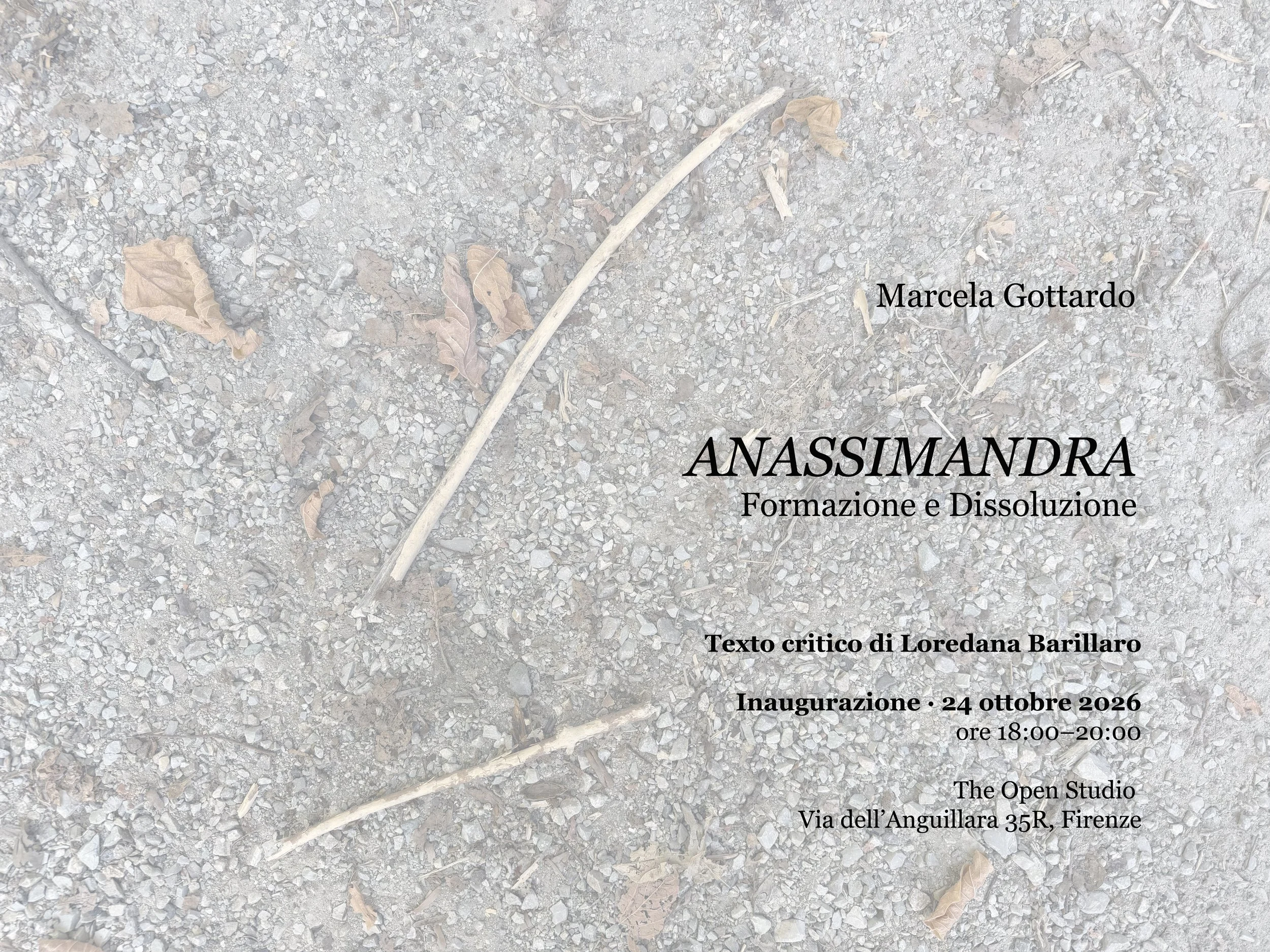
MARCELA GOTTARDO
ANASSIMANDRA: FORMAZIONE E DISSOLUZIONE
With this exhibition at The Open Studio Firenze, Marcela Gottardo introduces Anassimandra, an ongoing, open framework for research into how form, presence and meaning come into being.
The title echoes the name of the ancient Greek philosopher Anaximander and his conception of the apeiron: the indefinite and boundless principle from which things emerge and to which they return. Within Gottardo’s practice, Anassimandra opens a field of inquiry through encounters between matter, gesture, perception and space.
Formazione e Dissoluzione—Formation and Dissolution—is the first exhibition within this project. Its subtitle names the unstable threshold at which something becomes perceptible as a form, and the moment when its boundaries begin to loosen or disappear.
Bringing together clay, painting, paper, transformed book pages, beeswax and water, the exhibition unfolds across the gallery’s rooms. Clay suggests vessels, bodies, organisms and fragments without settling into a single identity. Painted marks gather into provisional images, while printed language becomes folded, layered matter.
Earth, fire, water and air participate in these transformations. The presence of fired and unfired ceramics reveals different states of matter and the transformations brought about by heat. Beeswax is melted into paper with a heated iron, altering its translucency, texture and rigidity. Heat, absorption and evaporation leave traces of processes through which materials take on—and relinquish—form. Water held in a dark ceramic basin receives the changing reflections of the surrounding architecture, while its gradual evaporation introduces a less immediately visible transformation.
The relationships between these elements are central to the exhibition. Openings, folds, cavities and surfaces respond to one another across different heights and distances. As visitors move through the space, these relationships shift, allowing new associations and meanings to emerge.
Anassimandra: Formazione e Dissoluzione invites a sustained encounter with forms in transition, where recognition remains open and looking participates in what comes into being.